Which job to automate first
List the jobs you are actually choosing between. The ranking reorders as you type, and the answer explains why the winner beat the job that eats the most time, because those are usually not the same job.
- FREE
- NO EMAIL
- 3 MINUTES
- NOTHING SAVED OR SENT
List the jobs you are actually choosing between. The three below are an example: overwrite them, or remove them.
AUTOMATE THIS ONE FIRST
Chasing unpaid invoices
2.5 hours a week, ease 100 out of 100, priority 150
Not Onboarding a new customer, which eats more time and would take longer to finish.
WORKED EXAMPLE, NOT YOUR ANSWERS
Three jobs on the table. Onboarding a new customer eats the most time by a clear margin, three hours a week, and it is the one everybody complains about. It comes third.
It loses because most cases need thought and it touches four systems. The winner, chasing unpaid invoices, eats half an hour a week less and is the same steps every time in one system: finished and running while onboarding was still being scoped.
- Chasing unpaid invoices
- 150
- The weekly management report
- 84
- Onboarding a new customer
- 68
- Onboarding, in raw hours
- 3.0 hrs
How the ranking is built
The whole calculation, printed rather than described. A ranking whose arithmetic is hidden is an opinion with a number attached to it.
- 01Value is your own minutesTimes a week, multiplied by minutes each time. That is it. Nothing is scaled up, discounted or compared against anybody else's figures.
- 02Ease is 75 per cent rule-based plus 25 per cent systems, roundedRule-based scores 0, 35, 72 or 100, from every case different to the same steps every time. Systems touched scores 100, 85, 65 or 45, from one to four or more.
- 03Priority is value multiplied by easeWeekly minutes times the ease figure, divided by 100. It is a way of ordering a list, not a forecast, and it has no meaning outside your own list.
- 04The winner is explained against the biggest jobNot against the runner-up, when those differ. People assume the job that eats the most time is the one to start with, so that is the comparison the tool makes out loud.
How the ranking works
- Why is judgement weighted three times as heavily as the number of systems?
- Because a job that needs somebody to think about most cases cannot be handed over yet, whereas one touching four systems can; it just takes longer to build. The weighting is a judgement, not a finding, so it is printed rather than buried.
- Is the priority number comparable to anything?
- No. It orders your own list and nothing else: a priority of 150 is not good or bad, it simply beats 84 on the same list. No industry benchmark is quoted because no sourced one exists, and an invented one would be worthless.
- How is this different from the ROI calculator?
- That one prices a single job in pounds: what it costs you a year, what a build costs, how long the payback takes. This one chooses which job to price. Run this first, then take the winner next door.
- How is this different from build, buy or wait?
- That one picks a route for a job you have already chosen: a no-code platform, n8n, a custom build, or waiting. This one picks the job. Different question, and running them in that order saves a wasted answer.
- What if the biggest job is not the winner?
- That is the usual result, and the reason the tool exists. The biggest job often needs the most judgement, which makes it the slowest to finish and the likeliest to be quietly wrong. The tool names that job and says why it lost.
- What if nothing on our list is rule-based?
- Then it says so rather than forcing a winner. Split the routine cases from the awkward ones, list the routine paths as separate jobs, and rank those: that is where the first automation lives.
Carry on next door
Disagree with the ranking
The weighting is published so you can. If the answer looks wrong for reasons the tool cannot see, that is a useful twenty minutes with us rather than a wasted one.
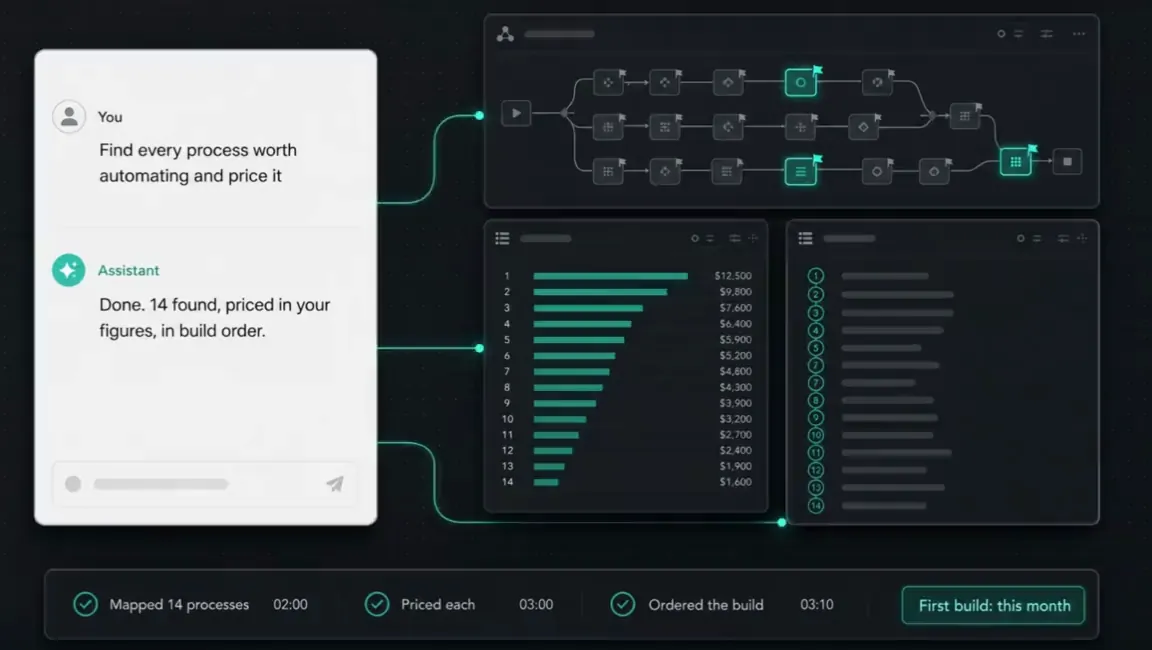
Ran your numbers? Send us the figures and we will come back with a fixed price, or book twenty minutes and talk them through.
Elsewhere on this site
Each service is its own page. Pricing, the FAQ, the Manchester company page, the free tools and the blog sit alongside them.
Services
- SEO automation
- Content production
- Social media automation
- Brand and video production
- Paid ads automation
- Email marketing automation
- Lead qualification
- CRM automation
- Outbound automation
- AI voice agents, outbound
- Proposals and quotes
- Inbound automation
- AI chat widget
- AI voice agents, inbound
- WhatsApp and SMS
- Document processing
- Invoicing and payment chasing
- Reporting and dashboards
- Scheduling and onboarding
- Recruitment and HR
- Website design and build
- Custom software and apps
- AI agent development
- System integration
- Knowledge base and search
- Your whole stack, inside Claude
- Team training and upskilling
- AI strategy and roadmap
- Support and maintenance
